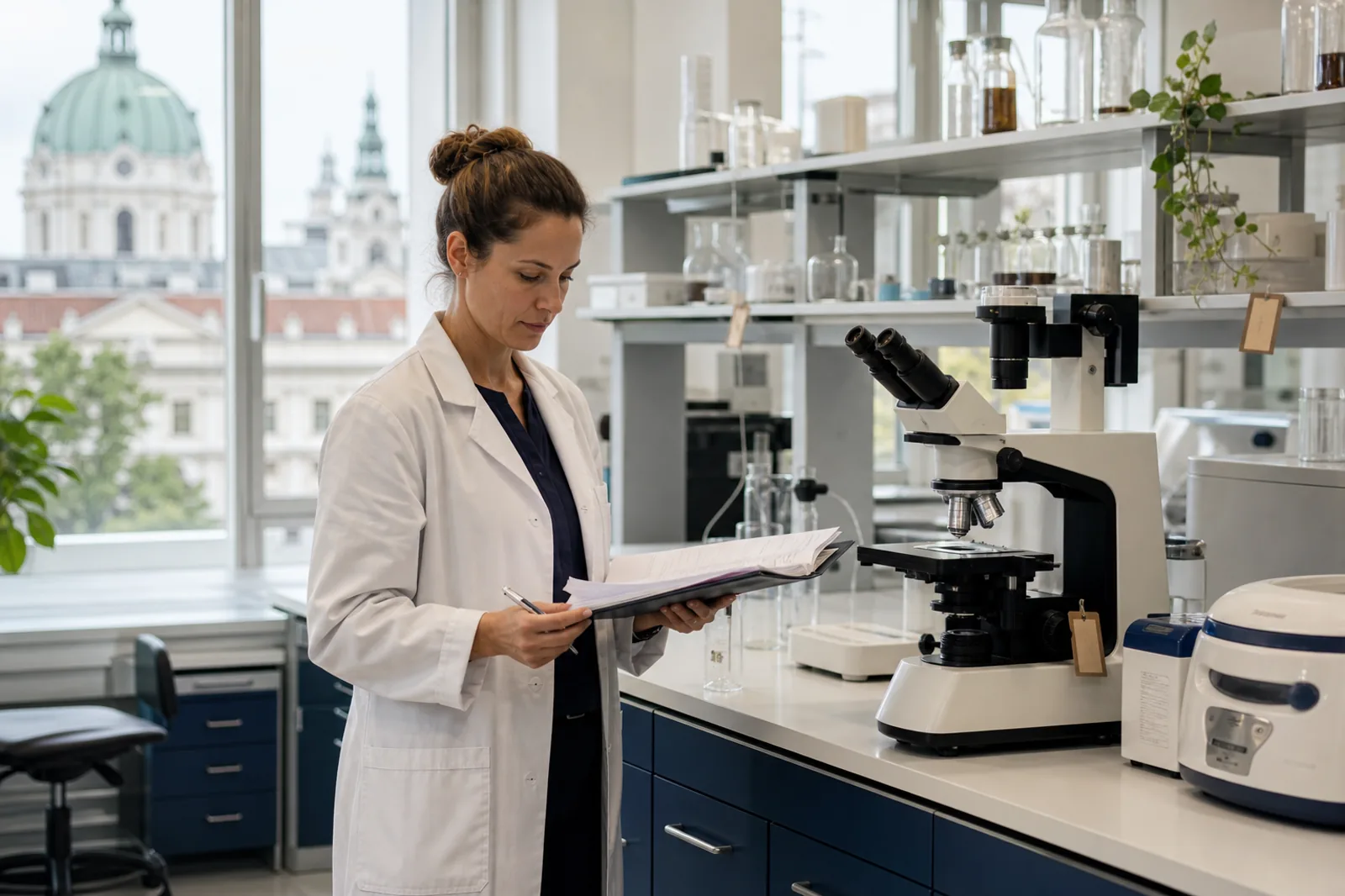
Short answer: a circular laboratory tries to retain the useful value of equipment and materials for longer while reducing avoidable procurement and disposal. For instruments, the practical sequence is inventory, utilisation evidence, preventive maintenance, internal reuse, carefully governed external access, repair and only then responsible retirement. Environmental savings must be measured for the actual scenario; they should not be inferred from a booking count alone.
Move from a waste story to an asset system
The European Commission describes circularity as moving away from a take-make-waste model and maintaining value with less material use. In a laboratory, this is not achieved by a green label on procurement. It requires ownership, records and decisions across an instrument’s full life: selection, installation, qualification, operation, maintenance, access, repair and retirement.
Scientific quality remains the first constraint. A device that cannot meet method requirements should not be kept in service merely to avoid replacement. Circular management instead makes the decision traceable: what performance is required, what condition is observed, whether repair or upgrade is viable, and which route creates the lowest operational risk.
Create an equipment register that supports decisions
A useful register contains more than manufacturer and serial number. Record location, responsible owner, configuration, software dependencies, service state, qualification status, permitted operators, typical workflows and restrictions on external access. Add a simple utilisation measure that reflects reality for that class of instrument. Calendar hours may work for some devices; completed runs or sample batches may be better for others.
Quarterly review questions
- Is the equipment still technically fit for its intended methods?
- Are maintenance, calibration and software records current?
- Which planned projects need capacity in the next quarter?
- Can unused internal capacity be offered elsewhere in the organisation?
- Would external access be safe, permitted and operationally worthwhile?
- If retirement is proposed, what evidence rules out repair, upgrade or transfer?
Use a hierarchy for underused equipment
| Priority | Action | Evidence needed |
|---|---|---|
| 1 | Improve internal scheduling and awareness | Demand, conflicts and operator availability |
| 2 | Maintain, repair or upgrade | Condition, supportability and method requirements |
| 3 | Transfer within the organisation | Receiving team, space, qualification and ownership |
| 4 | Offer governed external access | Permission, safety, confidentiality, capacity and support |
| 5 | Retire through an approved route | Data removal, decontamination and waste obligations |
Why sharing can support circularity
Where suitable capacity exists, shared access may increase the useful work produced by an installed asset and reduce pressure for duplicate purchases. That is a plausible circular mechanism, not an automatic carbon result. A credible comparison needs the actual alternative: would the requesting team otherwise buy a device, use another facility, postpone the experiment or change its method? Travel, additional runs, maintenance and consumables also affect the result.
This is why LabWallio does not publish a fixed carbon-saving coefficient as a production fact. A future impact method would need transparent boundaries, versioned assumptions, source data and a clear statement of uncertainty. Until then, teams can report operational facts—such as an approved shared session or avoided duplicate procurement decision—without translating them into unsupported emissions numbers.
Separate equipment sharing from material transfer
Sharing an installed instrument is not the same as transferring chemicals, biological material or regulated samples between organisations. Those activities introduce distinct questions about classification, permits, chain of custody, transport, storage and disposal. LabWallio’s initial scope keeps the instrument at the host laboratory and does not activate a chemical marketplace or LabWallio-managed logistics.
For samples used during an on-site visit, the host’s approved rules remain authoritative. The parties should confirm allowed material, packaging, arrival, local handling and removal or disposal before the visit. Marketing language cannot replace those controls.
A 90-day improvement cycle
- Weeks 1–2: assign owners and build the minimum equipment register.
- Weeks 3–4: select a small group of costly or constrained instruments and validate records.
- Month 2: observe demand, downtime, service issues and unused capacity without inventing precision.
- Month 3: make documented maintain, relocate, share or retire decisions for the pilot group.
- Repeat: review outcomes and expand only when the process is useful.
Related reading: the practical shared-access guide and the business decision framework.
Sources and further reading
- European Commission: circular economy strategy for research and innovation
- European Commission: Circular Economy Action Plan
- European Research Area actions for technology infrastructure access
This article provides an operational framework, not an environmental audit or legal disposal advice. Apply institutional safety, procurement and waste procedures.